
Herndon Previous Residents by Era
One Herndon address has two parallel histories. The deed trail identifies ownership transfers; directories, census schedules, and notices supply clues about people at the address. Work from the newest verified parcel record backward, and label each result by source and record date. The Fairfax systems split the work among current assessment cards, Circuit Court Land Records, the Historic Records Center, libraries, and archives. A date gap does not mean the property had no owner or occupants.
| Source | Years It Covers | Where Held | What It Shows |
|---|---|---|---|
| Fairfax iCare parcel card | Current card, with displayed data date | Fairfax Department of Tax Administration | Owner, mailing and situs addresses, PIN, legal description, sales, values, and tax tabs |
| CPAN and Circuit land records | Index data 1980–present; book and image coverage 1742–1979 | CPAN subscription or public courthouse terminals | Party roles, instruments, recording dates, book or document references, and images where available |
| Historic Records Center deed and tax books | Deed books 1742–1942; land tax books 1851–1980 | Fairfax Historic Records Center | Earlier deeds, tax clues, wills, chancery, and records with known gaps |
| Directories and telephone books | Exact Herndon reverse run not published | Virginia Room and local reference collections | Address-first or name-first household and telephone clues |
| Federal census | 1790–1950, with the 1890 population loss | NARA, library databases, and census portals | Enumerated households and location context, not deed ownership |
Start with iCare when the address is current. Start with the Historic Records Center when the question reaches the earlier deed-book period. Use a reverse directory only to suggest an occupant, then test that clue against an ordinary directory, census, obituary, probate file, or deed. The Herndon city directory collections explain the historical shelf in more detail.
Start a Herndon Previous Residents Trail
Open the Fairfax iCare property search with the street number and street name. iCare recommends leaving the suffix blank when needed and supports wildcard searches around a street name. Its current parcel card separates the situs address from the owner mailing address. That distinction is important: a mailing address may be a post-office box, another locality, or another state, and it does not prove that the owner lived at the Herndon parcel.
Save the owner name exactly as shown, the PIN, legal description, and sales information. The legal description and PIN are the stronger bridge to older records because street names and numbers can change. Owner names can be withheld from internet display by written request, so an absent online owner field may require a different official access route rather than a guess.
| Situs address | The physical parcel location, used to begin the address history. |
|---|---|
| Owner mailing address | A separate contact field, not proof of occupancy at the parcel. |
| PIN | The parcel identifier that helps match assessment, map, and legal records. |
| Legal description | The lot, subdivision, or metes-and-bounds wording that can survive an address change. |
Herndon Previous Residents and CPAN Coverage
The useful Fairfax distinction is between an index and an image. CPAN gives land-record images from 1742 to the present, but its searchable index data begins in 1980, at book 5391 and later. Book and index images cover 1742 through 1979, books A1 through 5390. In practical terms, a record can be online without every era being equally searchable by the same fields. A name search that works for a recent deed may not be the right route for an older owner.
The public courthouse research-room terminals are the no-subscription alternative. The Land Records Research Room at 4110 Chain Bridge Road, Suite 317 is public Monday through Friday from 8:00 to 4:30. Land-record copies are listed at $0.50 per page, with a $2 certification charge; confirm current charges before ordering because staff-copy sizes and payment methods have separate instructions.
Tracing Previous Residents Through Fairfax Deeds
The deed chain moves backward through ownership, not automatically through residency. Start with the current iCare owner, then use the Fairfax Circuit Court land-record research route to find that owner as a grantee, the person who received an interest. The acquisition deed names the seller, usually the grantor. Search that seller as a prior grantee to locate the seller’s purchase deed, and repeat. Keep the PIN, legal description, recording date, and book or document reference next to every transfer to avoid joining a similarly named party to the wrong parcel.
- Copy the current owner, PIN, situs address, legal description, and last sales details from iCare.
- Search the owner as grantee near the acquisition date and select the matching deed or related instrument.
- Open or request the instrument, then record the grantor, grantee, recording date, consideration when shown, legal description, and prior reference.
- Search the seller or grantor as an earlier grantee, using the legal description and lot boundaries to separate same-name parties.
- Repeat backward, changing from CPAN or Land Records to HRC deed books and indexes when the era requires it.
- Grantor / grantee
- The grantor conveys an interest; the grantee receives it. Their roles reverse as the search moves to a prior purchase.
- Chain of title
- A dated sequence of recorded ownership transfers tied to the same parcel or legal description.
- Legal description
- The recorded lot, subdivision, or boundary description. It is more stable than a modern street address for older records.
Note: A deed may document a transaction or interest without showing who actually lived at the property during that period.
Herndon Previous Residents in HRC Books
The Historic Records Center deed finding aid is the key route for the 1742–1942 deed-book era. HRC also holds land tax books from 1851 to 1980, personal-property tax books from 1851 to 1939, wills from 1742 to 1935, chancery, order books, and historic vital records. Some early deed books include bills of sale, office bonds, manumissions, and apprenticeship indentures as well as property transfers, so the record type matters.
HRC’s finding aid warns that several deed-index and book ranges are missing. Loose papers from 1742 through 1865 were lost, stolen, or destroyed. Call 703-246-4168 or email CCRHistoricRecords@fairfaxcounty.gov before treating a negative result as final. Post-1942 physical index research belongs with Land Records, while earlier books have their own HRC chronology.
The HRC deed finding aid shows why a previous-resident search sometimes shifts from a modern index to dated books and staff guidance.
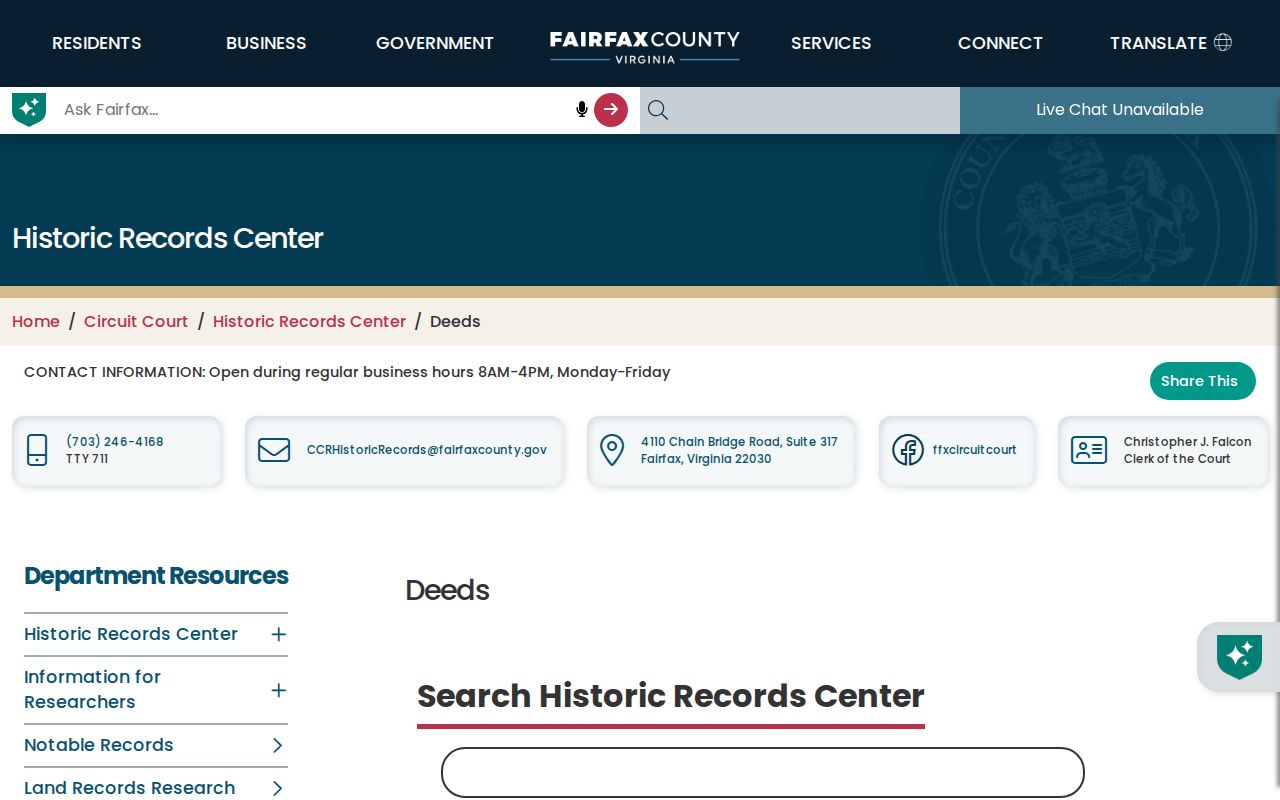
The HRC route preserves the chain when a recent portal search reaches an early indexing limit or a missing range.
Herndon Tax Books for Past Residents
Tax books can help date a parcel between deeds and modern assessment cards. Fairfax Circuit Court announced a 2025 Library of Virginia preservation grant of $21,450.60 to conserve the 1879 Atlas and the 1892, 1900, and 1910 Land Tax Books. Those items were in conservation as of June 2025. For an older Herndon house, a tax-book entry may connect an owner, lot description, and tax year when a city directory or online card does not reach far enough.
The Library of Virginia Fairfax local-records page is a useful companion for county microfilm and catalog leads. It does not replace the HRC. Instead, it gives another route when the property trail needs tax, deed, will, or other local-record context.
The Library of Virginia local-records catalog provides a starting view of archival material that can support a Herndon previous-residents timeline.
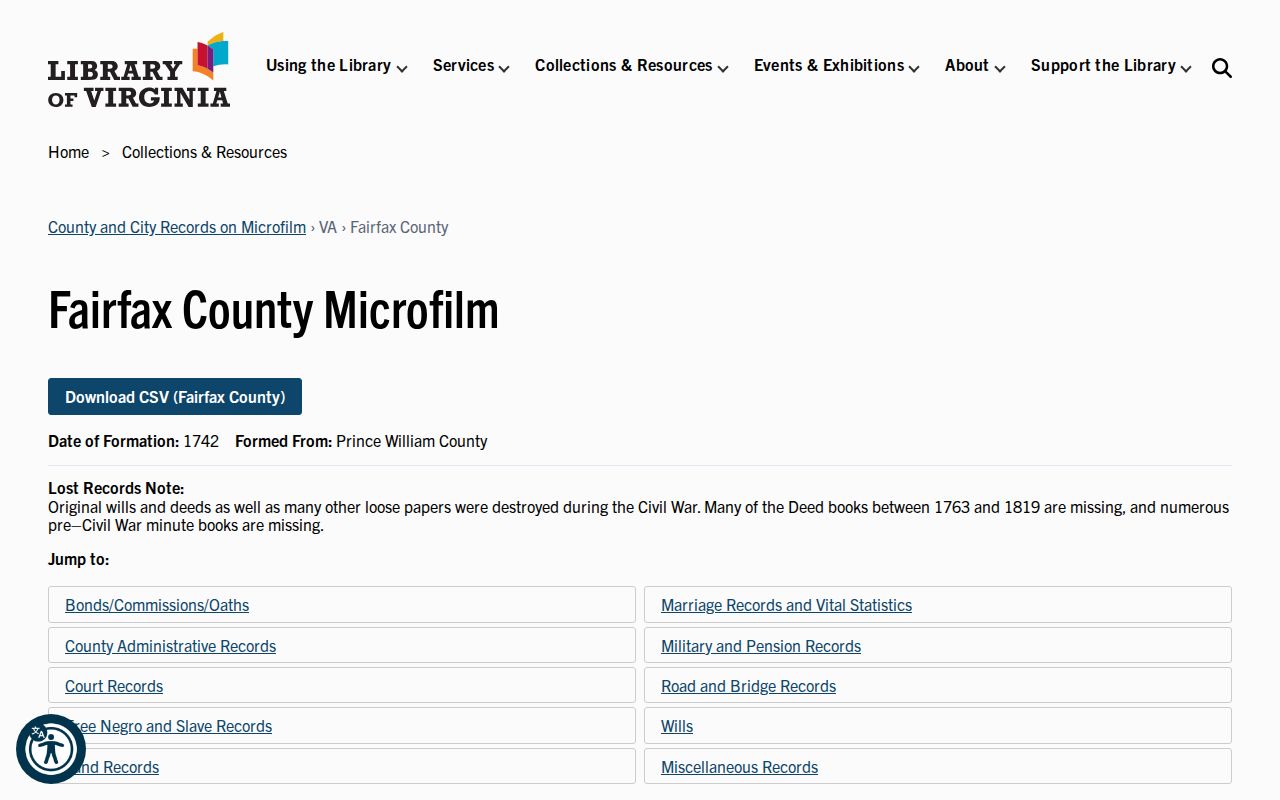
Tax entries should be read beside deeds and parcel descriptions, because a tax year can show a property connection without naming every person in the household.
Past Herndon Households in Directories and Census
Owners are only half the address story. Reverse or criss-cross directories can start with a street and number, then list an occupant or business for that edition. Ordinary city directories run name-first. The exact Herndon reverse-directory run is not published, so ask Virginia Room staff for the address-first volumes rather than assuming a particular year exists. Pair the directory date with the nearest released federal census, using 1790 through 1950 schedules while remembering the large loss of the 1890 population schedules.
The household flow is simple but needs dated evidence: address or legal description, then directory occupant clue, then census household, then newspaper or obituary, then probate if a death or estate is involved. An obituary can identify family relationships and a probate file may name heirs or fiduciaries. Neither proves that a survivor still lives at a former Herndon address.
- Find a dated address listing or reverse-directory entry and transcribe it with the source title and page.
- Check the ordinary directory for spelling, spouse, occupation, or a second street reference.
- Compare the closest federal census for the enumerated household and age context.
- Use newspaper notices, obituaries, probate, and deeds to test a move, death, or inheritance trail.
Lawful use. Herndon previous-resident research is for family history, house history, heir research, and civic curiosity. Do not use historical or current clues to stalk, harass, or track a living person.
Herndon Previous Residents and Missing Records
A missing result does not prove that no one lived at the address. Fairfax is a documented lost-records locality: deed books for 26 of 56 years from 1763 through 1819 are missing, most loose papers from 1742 through 1865 were lost, stolen, or destroyed, and early chancery and order-book coverage is incomplete. Herndon also lost much of its local library and Fortnightly material in the 1917 Crippen building fire. These are local limits with practical consequences for a house-history search.
When the trail breaks, compare HRC tax books and deeds, Virginia Room directories and newspapers, FamilySearch images, plats, the 1878 map, and a property’s legal description. No verified Herndon-wide street-renumbering project was found, so do not assert one. Use parcel, lot, owner, railroad landmarks, and MAR address dates to decide whether an older description points to the same place.
Note: Keep the recorded date and the date a portal was checked, because assessment, map, and digitized collections can change after a search.