
Herndon City Directory Collections
Herndon did not keep a separate county-style directory shelf. The useful historical listings sit in Fairfax-area collections, particularly the Fairfax County Public Library Virginia Room and the Library of Virginia reference material. A city directory can identify a likely household, but the surrounding county matters because Herndon residents may appear under Herndon, Fairfax County, a route heading, or a regional telephone listing. Start with a date and an address or surname, then ask staff to confirm that a particular volume includes Herndon pages.
| Collection | Years | Where Held | Access |
|---|---|---|---|
| Digitized and cataloged Fairfax-area directories | 1877, 1878, 1880, 1884, 1888, 1890, 1897, 1906, 1911 | Library of Virginia reference list and Virginia Room resources | Check title, locality, and Herndon pages before relying on a volume |
| Chataigne Virginia State Gazetteer and Business Directory | 1887 cataloged lead | Online Books and library catalogs | Business and person lead, not a complete resident roll |
| Reverse or criss-cross telephone directories | Exact Herndon run not published | Virginia Room telephone and directory resources | Ask staff for address-first volumes |
| Telephone books and local newspapers | Exact runs vary | Virginia Room and Herndon Fortnightly Library | In-library and staff-assisted research may be needed |
No verified first or last year for a Herndon-only printed city directory was found in the public sources. That is a real limit, not a gap to paper over. The documented Fairfax-area dates are research leads, while later suburban, telephone, and reverse listings need a staff check for the actual title and run.
Herndon City Directory Shelf at Virginia Room
The Fairfax County Virginia Room is the best local starting point for a city directory search. It is on the second floor of the City of Fairfax Regional Library and brings together regional genealogy, maps, photographs, manuscripts, newspapers, rare books, government information, and school yearbooks. Its online resources specifically include City Directories & Telephone Books and a Fairfax County property-history resource. The room also has microform readers that can print or save material to USB, plus a designated CPAN station for Fairfax Circuit land-record information.
The Virginia Room local-history page shows the range of research collections available before a visit. It does not publish a complete directory shelf list, so contact the room at 703-293-6227, option 6, or va_room@fairfaxcounty.gov with the surname, address, and target period first.
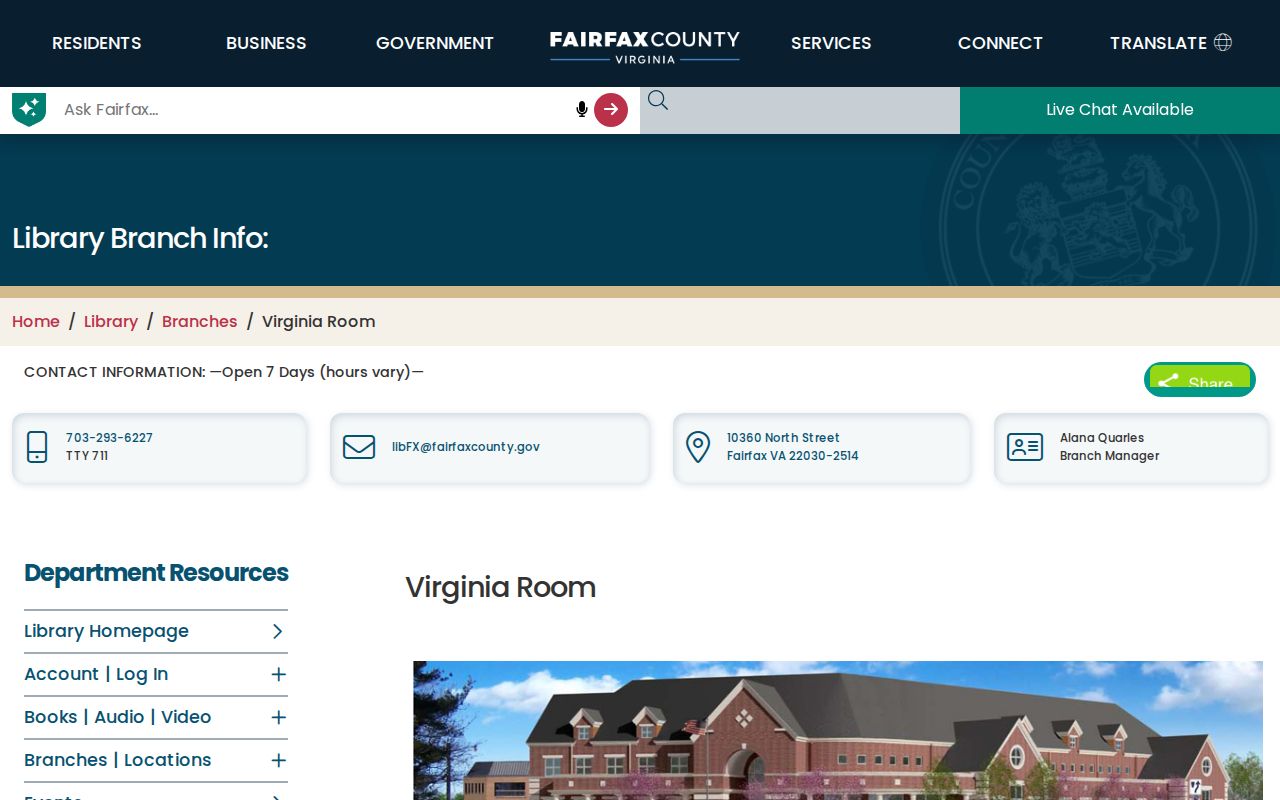
The Virginia Room is useful because it connects the printed city directory clue to maps, newspapers, yearbooks, and the county land-record trail in one research setting.
Herndon City Directory Leads, 1877 to 1911
The Library of Virginia Fairfax local-records catalog points researchers to county material and microfilm resources. Its digitized-directory reference identifies Fairfax County volumes dated 1877, 1878, 1880, 1884, 1888, 1890, 1897, 1906, and 1911, with multiple publishers and titles. Those dates establish that Fairfax-area directory material survives. They do not show that every book is on a Herndon shelf or that every issue contains an equally detailed Herndon list.
Use the dates as stops in a chronology. A gap between listed volumes is often a reason to switch to a tax book, newspaper, deed, or census schedule instead of assuming a family left town. The 1890 federal population schedules were largely lost, so a missing directory or census result in that period deserves another source.
- 1877–1890: Fairfax-area directory leads establish an early printed trail.
- 1897: A later cataloged Fairfax-area volume can bridge the turn of the century.
- 1906 and 1911: Pair each listing with the 1900 or 1910 census, as the dates allow.
- Later years: Ask for regional telephone, Polk, and reverse directories because no final Herndon-only print year is verified.
Note: A cataloged date identifies a research lead, while the title page and local pages establish what a particular directory actually covers.
The 1917 Fire and Herndon Directory Gaps
Local gaps have a specific Herndon cause. The Herndon Historical Society reports that the 1917 Crippen building fire destroyed much of the town and Fortnightly material. A missing local name, notice, or directory reference may reflect that loss rather than a missing household. The historical record should be read as a set of surviving fragments, not as one complete roll of everyone who lived in town.
The Society maintains a research library at the Depot Museum on Lynn Street, and says copies are also located at the Depot, Herndon Fortnightly Library, and the Virginia Room. Its historic-home-registry files can add a building or owner story to a bare address, although the source chain behind any local-history claim still deserves checking against deeds, tax books, or contemporaneous notices.
Reading a Herndon City Directory Entry
A city directory is usually an index clue, not a certified statement of residence. The official collection research did not expose a fully legible Herndon sample entry, so no sample name or symbol should be invented. Instead, read the title page, introduction, and abbreviation key in the actual volume before transcribing an entry. Ordinary directories are usually name-first. Reverse or criss-cross volumes begin with an address or street and then name the listed occupant or business.
| Cataloged identity | Publisher, title, year, county or locality, and directory type. |
|---|---|
| Name field | Surname and given name, sometimes initials or a spouse/relationship notation. |
| Work field | Occupation or employer when the volume includes one. |
| Address field | Street and number, telephone, and any owner, occupant, or widow abbreviation used by that volume. |
| Entry limits | A listing may be a business, mailing, or historical clue, not proof of a present household. |
- Criss-cross directory
- An address-first directory. It can turn a street number into a listed occupant or business for that edition.
- Householder index
- A name list organized around the household head or listed resident, rather than every person in a dwelling.
- Abbreviation key
- The publisher’s explanation of marks and shortened words, usually near the front of the volume. Capture it with the entry.
Compare spelling, initials, spouse references, occupation, and street form across adjacent years. That simple check helps separate two Fairfax residents with the same surname and prevents an address abbreviation from being treated as a move.
Herndon City Directory Companions
Directories work better beside other local collections. The Virginia Room maintains local newspapers and historical-newspaper resources, where a search by surname plus Herndon, a street name, church, business, or funeral home can surface moves and family ties. Read nearby notices as well as the first match. Obituaries may name a spouse, children, siblings, pallbearers, or a residence, while probate notices can identify fiduciaries or heirs.
The Virginia Room’s local-history yearbook collection offers more than 300 digitized Fairfax County Public Schools yearbooks and nearly 500 physical volumes across 36 schools. Yearbooks are useful for reconnecting classmates and testing a name, but they are not an official resident roll. The Herndon Fortnightly Library adds local reference help and newspaper access when a directory date needs context.
Herndon City Directory Research Beyond Shelves
Directory work often starts in a library and continues in archives. The FamilySearch Virginia Wills and Deeds collection provides indexed and image material from the 1700s through 2017, although coverage varies by county and book. The Library of Virginia points to Fairfax local-records and microfilm resources. A deed or will can test the owner, relationship, or property connection suggested by a directory entry.
The FamilySearch collection is a useful complement when a city directory gives only a name or street. It should not replace the original Fairfax record, because image access and the indexed fields vary across the collection.
Pairing a city directory clue with a deed, tax book, or probate file can establish a dated property connection without turning one printed listing into a complete family history.
Tracing a Herndon City Directory Household
For family history, record each result in date order rather than merging every similar name. Begin with the first confirmed listing, then follow the household through the next available directory or telephone volume. Pair a 1906 directory clue with the 1900 and 1910 census schedules, for example. Census residence means where a household was enumerated, while a deed records an ownership transaction. The two sources answer different questions.
- Find the earliest directory listing that matches the name, address, spouse, or work detail already known.
- Record the title, year, page, street form, and every abbreviation exactly as printed.
- Check an address-first volume, if available, to see whether the same address supports the identification.
- Compare the nearest released federal census for household structure and age context.
- Use newspapers, obituaries, probate, or a deed only to test the next move, death, or ownership change.
A disappearance can mean a move, death, a missed listing, a spelling change, or a different directory scope. Test those possibilities with dated records. When a historical listing needs a modern official check, use the Herndon resident lookup records rather than treating an old entry as a current address.
A Herndon City Directory Is Not a Current Address
A common mistake is to read an old city directory as proof that someone lives at the printed address now. It is not. The record reflects the publisher’s collection and publication period, and it can contain a business listing, an abbreviated address, or a person who had already moved. The same caution applies to an owner’s mailing address on a current parcel card, which is distinct from the property’s physical situs address.
Fairfax historical research also has real loss points. The Historic Records Center reports missing deed-index and book ranges, while much loose county paper from 1742 through 1865 was lost, stolen, or destroyed. A blank directory, deed, or census search should lead to a second source such as tax books, newspapers, FamilySearch, or a staff availability check, not to a confident negative conclusion.
Note: Historical names and addresses are best used for family, property, and community history, never to track or harass a living person.